
God Is a Mirror
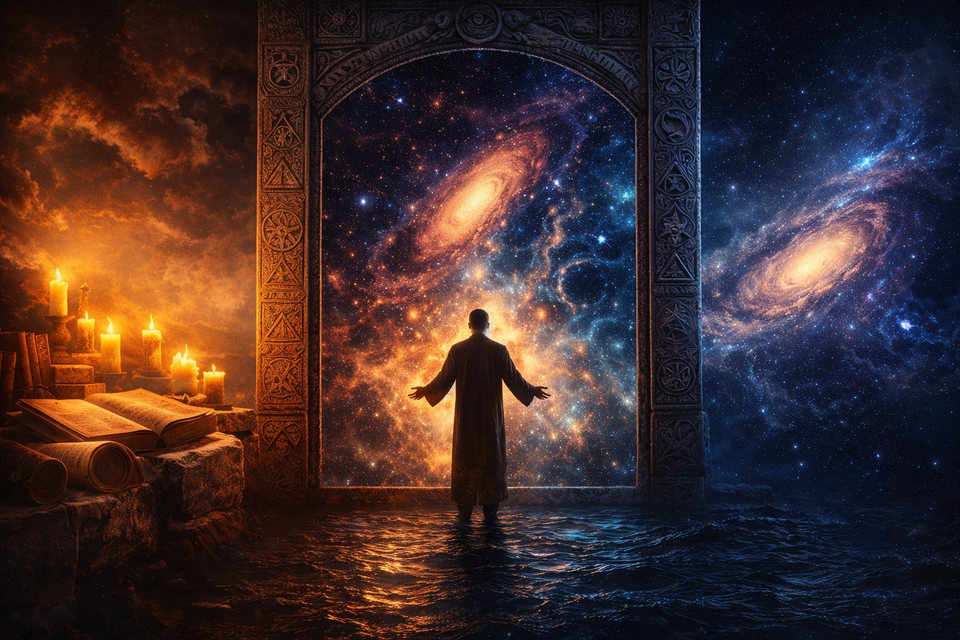
On religion, the mystery we cannot name, and the personal God we must each build for ourselves.
Here is something strange that happens when you pursue knowledge seriously: the more you learn, the less certain you become. The more doors you open, the more corridors appear behind them. The more answers you collect, the heavier the unanswered questions grow. This is not a failure of intellect. It is intellect working exactly as it should. And it leads, eventually, to one of the most uncomfortable truths a thinking person can face — that at the bottom of all our knowing is an ocean of ignorance we cannot cross.
Most people never reach that ocean. Not because they are incurious, but because something stops them before they get there. Often, that something is religion.
The Curtain We Mistake for the Wall
Religion is, among many things, a system of answers. It enters the spaces where human understanding runs out and fills them — with story, with symbol, with doctrine, with a God who explains what science and philosophy cannot yet reach. For thousands of years, this has been enormously comforting and, in many ways, useful. It binds communities. It provides moral scaffolding. It gives suffering a name and a purpose. It turns the terrifying randomness of existence into a narrative with a beginning, a meaning, and an end.
But there is a cost. The answers religion provides are, in many cases, not discoveries — they are constructions. Beautiful constructions, often. Profound constructions, sometimes. But constructions nonetheless — fabricated truths dressed in the language of the absolute, offered to minds that are hungry enough to accept them without question.
Religion, at its most seductive, does not invite you to keep searching. It invites you to stop. It places a curtain in front of the mystery and tells you the curtain is the wall. It offers the map as a substitute for the territory. And the map is so beautifully drawn, so reassuringly detailed, that most people never think to ask what lies beyond its edges.
What Religion Actually Is
Strip away the theology, the ritual, and the institution, and what you find at the root of every religion is something remarkably human: the attempt to explain the unexplainable. To put a frame around what has no frame. To give a name to what refuses to be named.
Religion was born in the same moment a human being first looked at the night sky and felt the vertigo of not knowing. It was born in the first thunderstorm that had no explanation, the first death that made no sense, the first question that had no answer. It is the product of imagination — specifically, of the extraordinary human imagination that cannot tolerate a blank space and must fill it with something, anything, that gives it shape.
This is not an insult. It is a recognition of something remarkable. No other creature on Earth builds cathedrals. No other animal writes scripture. No other being invents the divine. Religion is a testament to the uniqueness of the human mind — its beauty, its creativity, and its profound, aching need to make sense of a world that does not owe it any sense at all.
"God is the personification of mystery as it matures in time — a projection of man of himself as a perfect being, in contrast to his imperfections."
God as Self-Portrait
This is perhaps the most important observation of all: the God of any religion looks remarkably like the people who worship him. The God of a warrior tribe is a God of battles. The God of a legalistic society is a God of laws and judgment. The God of a loving community is a God of mercy and grace. The divine, in every tradition, reflects the values, fears, and aspirations of the culture that created it.
Jung understood this deeply. He saw God not as an external being to be believed in or rejected, but as an archetype — a projection of the deepest layers of the human psyche onto the cosmos. We take our own potential for perfection, our own ideal of what we could be at our very best — all-knowing, all-loving, all-powerful — and we place it outside ourselves, call it God, and then worship it from a distance.
In this sense, God is not a lie. God is a mirror. The most honest mirror humanity has ever built — reflecting back to us everything we most deeply want to become, and everything we most deeply fear we never will.
The Mystery Is Not the Enemy
What happens when we stop filling the mystery with ready-made answers? What happens when we pull back the curtain and stare at the unknown without the comfort of doctrine?
For many people, this is terrifying. The structured religion was not just answering questions — it was managing anxiety. And without it, the anxiety returns in full force. This is why so many people, even when they intellectually outgrow their inherited religion, cannot bring themselves to leave it. The mystery is too cold. The uncertainty is too vast.
But there is another way to meet the mystery. Not with fear, but with wonder. Not as a problem to be solved, but as a horizon to be walked toward — knowing you will never reach it, but finding meaning and beauty in every step. This is the posture of the true philosopher, the true scientist, and the truly spiritual person: comfortable in not knowing, perpetually curious, perpetually alive to the strangeness and the magnificence of being here at all.
"The most beautiful thing we can experience is the mysterious. It is the source of all true art and science." — Albert Einstein
Building Your Own God — The Einstein Path
Modern life has quietly dismantled many of the old certainties. The walls of structured religion are thinner than they were. People leave churches not in anger but in quiet, searching for something more honest, more personal, more aligned with what they have actually experienced of reality.
What they are searching for — often without knowing it — is what Einstein found in Spinoza: a God that is not a ruler, not a judge, not a being who intervenes in history and answers prayers, but something more profound and more mysterious — the intelligence, the order, the breathtaking coherence embedded in the structure of reality itself. The God that is not above nature, but is nature. Not a person who created the universe, but the universe revealing itself as something far too ordered, too beautiful, too strangely precise to be meaningless.
When Einstein said "My God is the God of Spinoza," he was not abandoning the sacred. He was expanding it — past the walls of inherited doctrine, past the curtain of fabricated certainty, into the open and magnificent mystery that those walls were always only hiding. He built his own God. A God honest enough to admit it could not be fully known. A God large enough to hold both science and awe.
What This Means for How We Live
To free yourself from structured religion does not mean to become cold, cynical, or spiritually empty. It means to take responsibility for your own metaphysical life — to stop outsourcing your deepest questions to an institution and to start sitting with them yourself, honestly, humbly, and without the comfort of pre-packaged answers.
It means building your own relationship with the mystery — not through scripture someone else wrote, but through your own experience, your own reason, your own encounters with beauty, grief, love, and the inexplicable strangeness of being alive. It means becoming, in the deepest sense, spiritually adult.
The mystery will not go away. No amount of science, philosophy, or religion will ever fully dissolve it. The more we know, the deeper it gets. That is not a tragedy. That is the most extraordinary gift existence has given us — a universe so vast, so strange, and so endlessly unfolding that we will never exhaust the wonder of living inside it.
· · ·
God, in the end, may be the name we give to everything we do not yet understand — and everything we sense, in our most honest and quiet moments, that we never fully will. That is not nothing. That is, perhaps, everything.
"Dig deep enough into any question
and you will find not an answer —
but a wider, more beautiful mystery."
DISCLAIMER:
This article expands on a personal philosophical reflection on religion, knowledge, and the nature of God — drawing on ideas from Baruch Spinoza, Carl Jung, Albert Einstein, and the broader tradition of philosophical inquiry into the human experience of the sacred. It is not anti-religion. It is an invitation to go deeper than religion alone can take us.