
The Warrior Never Came Home
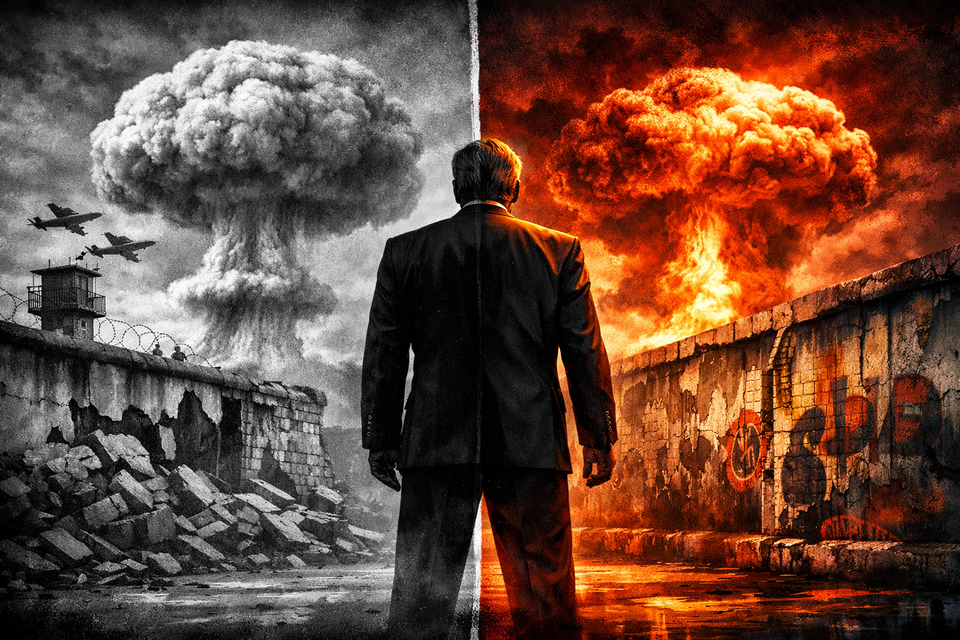
Is Donald Trump still fighting a Cold War that ended thirty years ago? A Jungian look at how an entire generation was psychologically imprinted by the most violent century in human history — and what happens when that imprinting runs a country.
Donald Trump was born in 1946 — the very first year of the Baby Boomer generation, and almost to the month after the atomic bomb ended the most catastrophic war in human history. He grew up in a New York shaped by victory parades, nuclear drills, bomb shelters, and a national obsession with dominance, enemies, and the existential terror of annihilation. Before he could form a coherent worldview, the world around him had already handed him one: life is combat, strength is survival, and weakness gets you killed.
This article does not seek to defend or condemn Trump the politician. It asks a deeper question — one that Jungian psychology is uniquely equipped to explore: What happens to the psyche of a child raised inside a civilization-wide trauma? And what does that psyche look like when it reaches the most powerful office on Earth?
"Until you make the unconscious conscious, it will direct your life and you will call it fate." — Carl Gustav Jung
Understanding the Jungian Framework
Carl Jung believed that human beings are not only shaped by personal experience — they are also shaped by what he called the collective unconscious: a deep layer of the psyche shared across cultures and generations, populated by universal patterns he called archetypes.
Archetypes are not ideas we choose. They are psychological templates — ancient, pre-programmed, emotionally loaded — that get activated by the experiences we live through. A child who grows up surrounded by war, threat, and the rhetoric of enemies does not merely learn about conflict. They absorb it at the archetypal level. It becomes the lens through which all of reality is interpreted.
When an archetype is activated by collective trauma — not just personal pain, but society-wide catastrophe — it doesn't stay in one person. It spreads. It becomes the dominant psychological theme of an entire generation. Jung called this phenomenon the constellation of a collective archetype: a single psychological pattern gripping millions of people simultaneously, shaping culture, politics, and behavior — often without anyone realizing it.
The Four Archetypes That Defined a Generation
The post-WWII and Cold War era did not activate one archetype — it activated several, in a volatile and explosive combination. To understand Trump's psychology, we must understand the psychic weather of the world he was born into.
The Warrior
The dominant archetype of the WWII generation. Strength, combat, dominance, victory at all costs. The Warrior does not negotiate — he defeats. He does not compromise — he conquers.
The Shadow
Jung's term for the rejected, feared parts of the self — projected outward onto enemies. In the Cold War psyche, the Shadow became the Communist, the foreigner, the traitor within. The other who must be destroyed.
The Hero
America's national self-image: the lone, righteous savior who defeats evil and restores order. The Hero archetype gave post-war America its mythology — and its dangerous tendency toward messianism.
The Great Father
Authority, order, hierarchy, and punishment. The patriarch who demands loyalty and punishes betrayal. A figure of protection — but also of domination and control when wounded.
A boy growing up in 1950s America — especially in the highly competitive, transactional world of New York real estate — would have been marinated in all four of these simultaneously. The culture said: be strong, identify your enemies, be the hero, dominate or be dominated. There was no alternative narrative.
The Cold War as Collective Psychological Imprinting
The Cold War was not merely a geopolitical event. It was a forty-year psychological operation conducted on the entire American population. From the moment Trump entered elementary school, the machinery of collective fear was running at full capacity.
1946 — Trump is born. The Cold War begins. Churchill delivers his Iron Curtain speech. The world divides into Us and Them.
1950s — Childhood & Early Formation. McCarthyism grips America. The enemy could be your neighbor. Loyalty tests. Blacklists. Nuclear drills in school. Duck and cover. The Warrior archetype is installed.
1962 — Age 16: Cuban Missile Crisis. The world comes within hours of nuclear annihilation. A formative adolescent experience: the threat is real, it is existential, and only the strongest survive.
1960s–70s — Young Adulthood. Vietnam. Assassinations. Watergate. A world of betrayal, strength, and the collapse of trusted authority — deepening the Shadow complex.
1980s — The Reagan Years. Trump builds his empire alongside Reagan's "Evil Empire" rhetoric. The Warrior and Hero archetypes fully consolidated. America = strength. Weakness = failure. Enemies = everywhere.
By the time the Cold War officially ended in 1991, Trump was 45 years old. The psychological imprinting was complete. The archetypes were not just activated — they were calcified into personality structure. The world had changed. The psyche had not.
"The most dangerous psychological state is not knowing you are still fighting a war that ended decades ago."
The Shadow at Work — Enemies Everywhere
Jung's concept of the Shadow is perhaps the most useful tool for understanding Trump's political behavior. The Shadow is not evil in itself — it is simply the repository of everything a person (or culture) refuses to acknowledge in itself. Weakness, fear, dependency, vulnerability. Everything that the Cold War Warrior archetype forbids.
When the Shadow is unexamined and unintegrated, it does not disappear. It gets projected outward — onto other people, other nations, other groups. They become the carriers of everything the psyche cannot face in itself. And the reaction is always disproportionate — because what triggers us most violently is always what we most refuse to see in the mirror.
This is the Jungian explanation for why Trump sees enemies in places others see allies, threats in places others see routine diplomacy, weakness and betrayal where others see compromise and cooperation. The Shadow-dominated psyche does not experience a world of nuance. It experiences a world of combat — constant, total, existential. Every negotiation is a battle. Every ally is a potential traitor. Every agreement is a potential trap. The Cold War never ended. It just moved into the Oval Office.
The Warrior Archetype and the Compulsion to Fight
The Warrior archetype, when healthy, is enormously valuable — it provides courage, discipline, protection, and the willingness to defend what matters. But Jung was clear: every archetype has a shadow expression. And the shadow Warrior is a figure who cannot stop fighting — not because enemies are real, but because fighting is the only identity they know.
Without a war, the shadow Warrior ceases to exist. His entire sense of self is organized around opposition. Remove the enemy and there is no Warrior — there is only a man who doesn't know who he is. And so the shadow Warrior does something predictable: he manufactures enemies when they don't exist, and escalates conflicts that could be resolved.
Tariffs as weapons. Trade partners reframed as economic enemies. NATO allies accused of betrayal. Domestic opponents described as existential threats. The language is always the language of total war — because the psyche knows no other grammar.
This Is Bigger Than One Person
It would be a mistake to read this analysis as an attack on Trump alone. Jungian psychology is not about blame — it is about understanding. And what makes this analysis genuinely important is that Trump does not represent an individual pathology. He represents a generational one.
The post-WWII and Cold War generation — the Silent Generation and early Boomers — were collectively imprinted with the same archetypal templates. Many of them, in positions of power across business, military, media, and government, carry the same Warrior shadow, the same projected Shadow, the same compulsion to frame every problem as a battle that must be won rather than a complexity that must be navigated.
Trump is not the cause. He is the symptom — the fullest expression of a collective psychological inheritance that an entire civilization has never properly processed. The war ended. The trauma didn't. And unprocessed trauma, as Jung understood better than almost anyone, does not heal by being ignored. It only grows louder.
"What we resist, persists. What we don't make conscious comes back to us as fate — and as politics."
What Would Integration Look Like?
Jung did not believe in the elimination of the Warrior or the Shadow. He believed in their integration. A person who has genuinely integrated their Warrior does not stop being strong — they become strong in service of something beyond themselves. They learn the difference between a real threat and a projected fear. They can sit at a table with an adversary without needing to dominate or destroy them.
A generation that integrated its post-war Shadow would not need to see enemies everywhere. It would be capable of the hardest thing any warrior must learn: that the greatest battles are interior ones, and that a nation — like a person — cannot build anything lasting while it is still living inside a war that ended decades ago.
The question for America — and for any society shaped by its particular historical traumas — is whether it will choose consciousness or compulsion. Whether it will examine what the 20th century did to its psyche, or whether it will keep electing the ghosts of that century to run the 21st.
"Every generation inherits a wound.
The question is whether it passes the wound forward
or finally stops to heal it."
DISCLAIMER:
This article applies Jungian depth psychology — including the concepts of archetypes, the Shadow, and collective unconscious — as an analytical lens on generational and political psychology. It is not a clinical diagnosis. It is a philosophical and psychological inquiry into how historical trauma shapes leadership, culture, and the choices a civilization makes about its future. References draw on the works of C.G. Jung, James Hollis (Why Good People Do Bad Things), and Marie-Louise von Franz on shadow projection.